

We make
student fitness
countable.
Schools are being asked to measure fitness again. Most have nothing to measure with. We build a non-contact rhythm and reaction station that counts every repetition, logs every session, and turns a PE period into evidence a district can actually report.
The order
came down.
The tools
never did.
In July 2025 the President reestablished the Presidential Fitness Test and directed the President's Council to build school-based programs that reward excellence in physical education. The battery is published. The award tiers are set. Schools began administering it this fall.
What was never built is the part that captures any of it. There is no federal recordkeeping system, no submission tool, and no educator guide — and the states were not ready either.
A study published this April in the CDC's journal Preventing Chronic Disease found that 24 states have no fitness testing requirement at all, only three require an annual assessment, and only six require results be submitted to a state agency. Its conclusion: state policies "are not positioned to support large-scale standardized fitness testing."
Killian et al., Preventing Chronic Disease, April 30, 2026It counts
while you
teach.
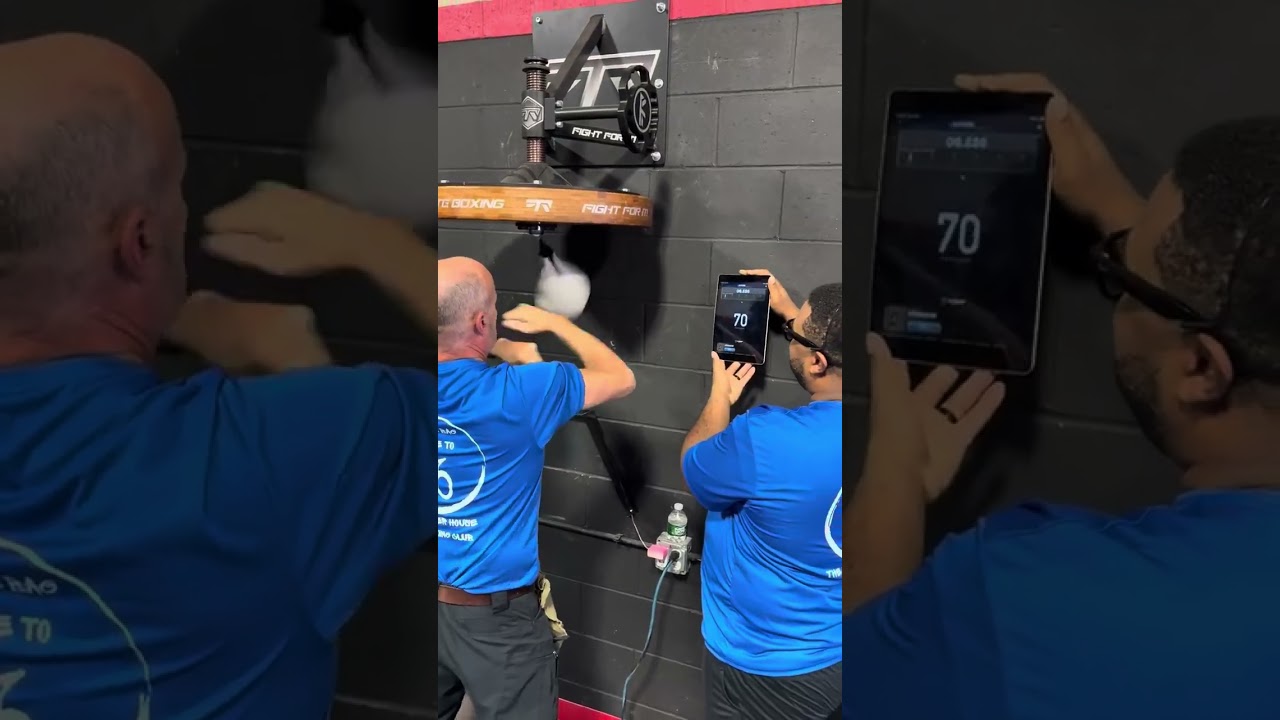
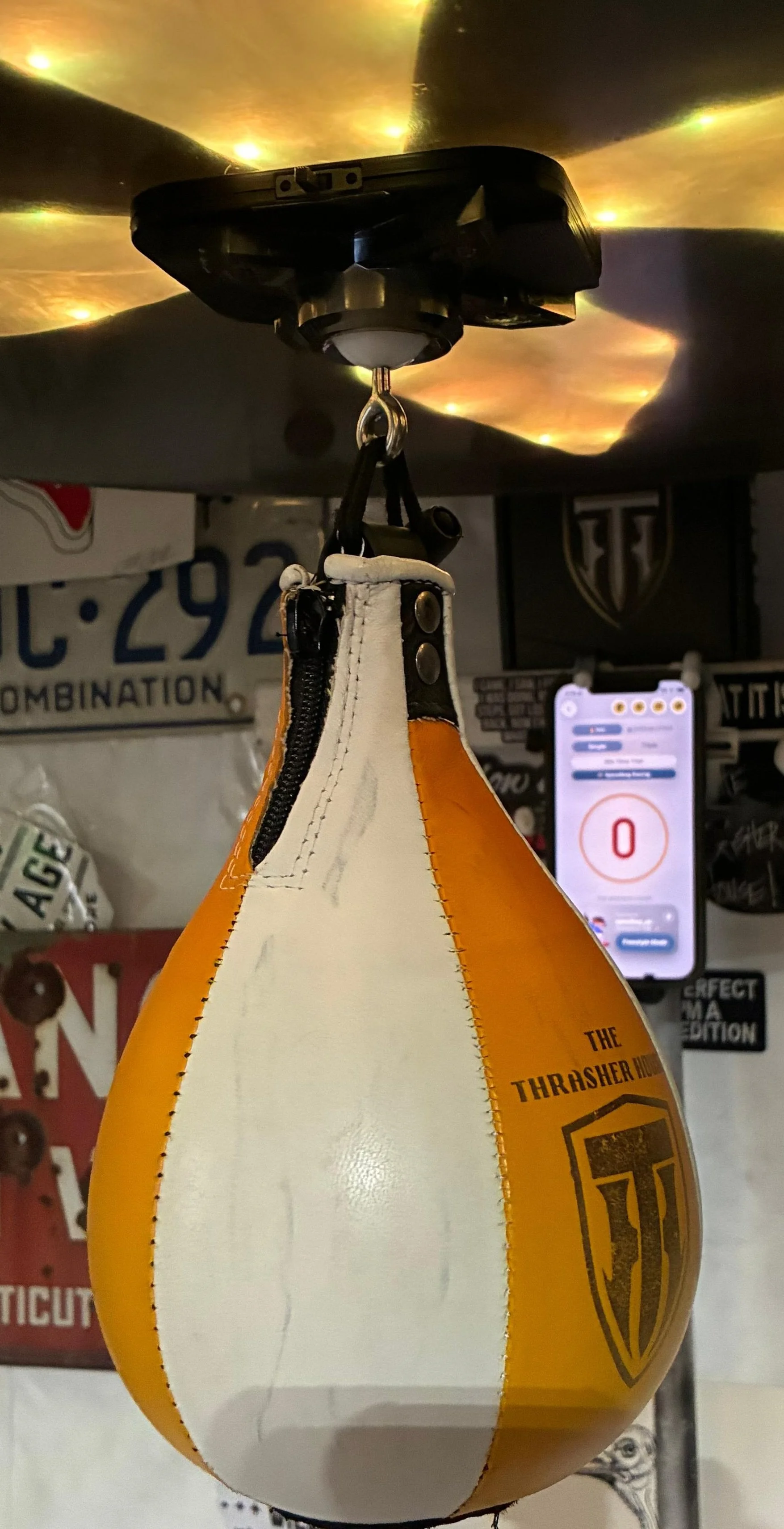
A student strikes a suspended rebound bag with alternating hands. An optical sensor counts every strike and logs the session — reps, longest streak, tempo, duration — with no teacher observation required.
That is the whole idea. The assessment artifact is generated while you teach, not instead of teaching.
- ✓Non-contact. No opponent, no partner, no impact to the participant, no head contact of any kind.
- ✓Scored on rhythm, not force. Striking harder breaks the tempo and lowers the count — the scoring system is itself a safety control.
- ✓Self-paced and non-comparative. Students compete against their own prior number. Not a running test; it does not sort children by build.
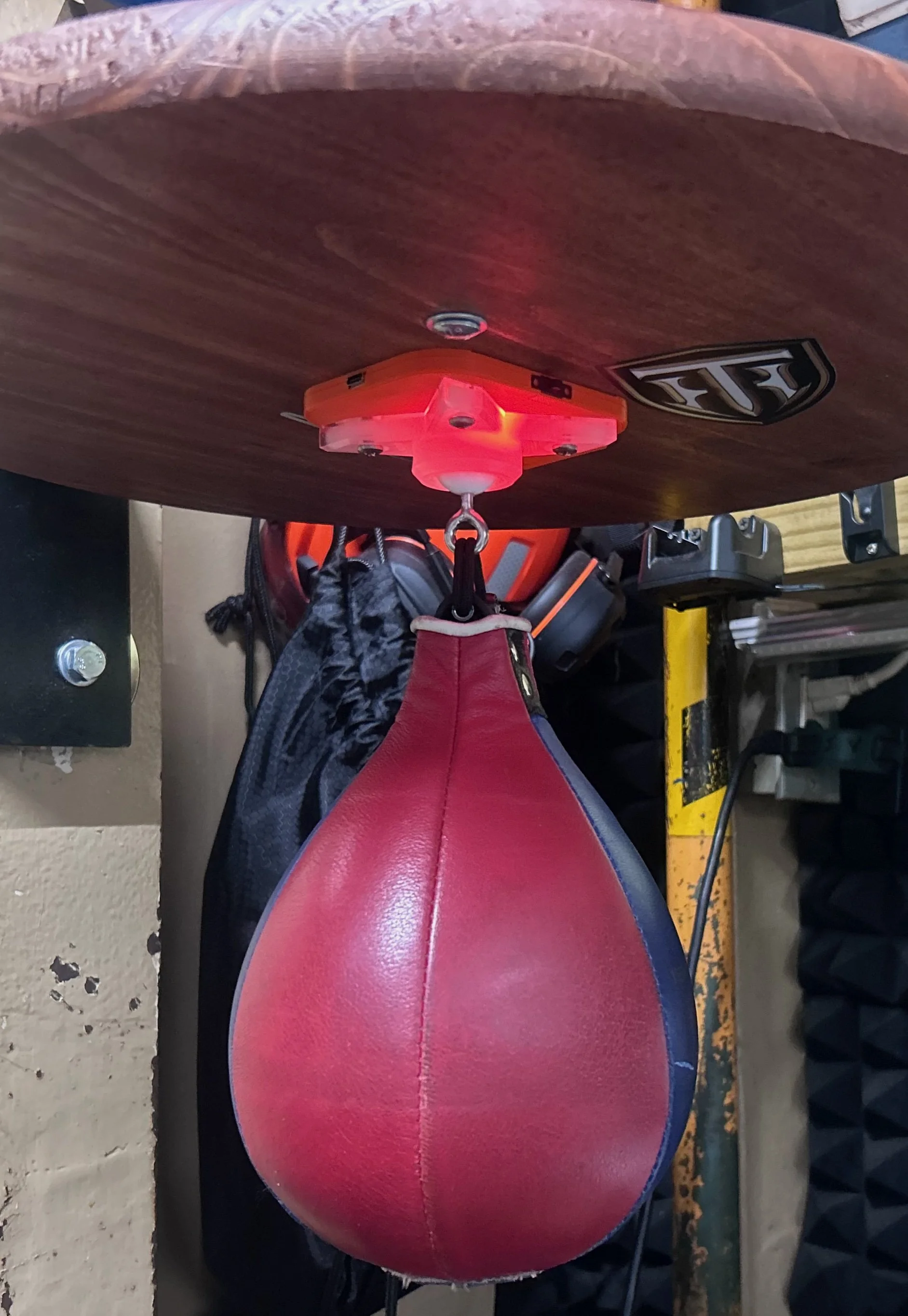
- ✓Seated or standing. Adjustable height means a student using a wheelchair does the same activity at the same station.
- ✓Portable. Freestanding rack option — a supply purchase, not a facilities request.
Every student gets a number
Reps, streaks, pace, and personal bests. For many students it is the first objective fitness number they have ever owned — and the first one that had nothing to do with how fast they run.
Growth is the score
Baseline in week one, post-test in week four, identical protocol both times. Because the count is machine-generated, the comparison is objective and repeatable across administrations.
Nothing to review
No student names. No student accounts. No personally identifiable information. Sessions log to anonymous station numbers on the teacher's own device — so there is no data agreement to negotiate.
It ships with
four weeks of
lesson plans.
Equipment is a line item. Curriculum is a program. Every station set includes a complete twelve-lesson unit written for three 40–45 minute sessions per week, with a technique rubric, a safety check-off, peer feedback forms, adapted-PE modifications, and scaling notes for other schedules.
Standards are mapped by code to the 2024 SHAPE America National Physical Education Standards and to California, Massachusetts, and Connecticut state standards — including the exact grade-band indicators each lesson produces evidence for.
Foundations
Safety, stance, fist and wrist mechanics, first contact. No student strikes a bag in lesson one — that is deliberate. Ends with the baseline test.
Rhythm
Alternating hands, sustained rhythm, tempo control. Students learn that their fastest tempo and their best tempo are not the same number.
Conditioning
Rounds, work-to-rest intervals, self-monitored intensity. This is where shoulder and arm endurance start showing up in push-up performance.
Application
Student-created movement patterns, a whole-class challenge, post-test, and written reflection. Growth is the grade.
Two lanes.
One countdown.
Nobody walks past.
Up to eight stations connect at once, side by side, first to the number. It runs as a PE station, a class challenge, a field-day event, or a school fundraiser. The engagement problem in physical education is not a mystery — students show up for things that feel like something.
This is also the honest answer to a fair question about fitness testing. When Education Week asked people what they remembered about the Presidential Fitness Test, 62% said embarrassment and 8% said a love of exercise. A race you can win against your own last score is a different experience than a mile run in front of your classmates.
Same station.
No separate
activity.
IDEA requires physical education be made available to every student with a disability, and requires the opportunity to participate in the regular program wherever possible. Most PE equipment answers that with a parallel activity off to the side. This does not.
- ✓No locomotion required — the single largest barrier in most PE activities is simply absent.
- ✓Seated participation at adjusted height — same task, same scoring, same rotation, same class.
- ✓Auditory feedback — the rebound rhythm is an audible cue, which many students track better by ear than by eye.
- ✓Objective IEP progress data — a dated, measurable session log, on a goal that is otherwise hard to evidence.
We wrote the paperwork before you asked.
Three documents, sent on request, no form to fill out. Most vendors make a district produce these themselves.
Standards alignment
Grade-band mapping to the 2024 SHAPE America standards with indicator codes, plus crosswalks to California, Massachusetts, and Connecticut. Names the student evidence each indicator produces.
Request itSafety & risk memo
Non-contact, no opponent, no impact to the participant. States the published injury literature plainly — including the finding that runs against us — and the controls that address it.
Request itFour-week unit
Twelve lessons, day by day, with a technique rubric, assessment protocol, grading weights, adapted-PE modifications, and scaling notes for two-day or five-day schedules.
Request itPriced to be a supply, not a project.
A station set sits below every K-12 competitive bid threshold we have checked, and below the $10,000 federal capitalization ceiling under 2 CFR 200.1 — so it is a supply, not capitalized equipment. No prior approval. No disposition tracking. This is a quote-and-PO purchase, not a bid.
Fundable with money districts already have.
Physical education equipment is an explicitly allowable use of Title IV-A funds under the well-rounded education and safe-and-healthy-students categories. We will help your federal programs office document it, and we will tell you honestly when a grant is a better fit than a purchase order.
Built here.
Held by the
person who
built it.
Athletic Interpretations is a small American hardware company in Los Angeles. Our founder holds U.S. Patent 9,937,402 for the sensing method that makes this work. Every device is tested in Los Angeles before it ships.
We started with the speed bag because it is the rare piece of athletic equipment that is pure rhythm — no contact, no opponent, no size or speed advantage — and because nothing on the market could count it. The same approach applies to every sport where effort has never been measurable.
Rhythm & Reaction Station
The flagship. Bluetooth rebound counter, companion app for iPhone and Android, and the four-week standards-aligned unit. In schools, gyms, and garages today.
Shot & Reaction Tracking
The same formula applied to the hoop — attempts, makes, and pace, counted automatically, so a driveway or a gym becomes a measurable station.
Track & Field Measurement
Precision timing and distance for the events schools already run, captured without a clipboard — aimed squarely at the fitness-test reporting gap.
Put one in a gym.
Then decide.
We would rather you see it work than read about it. Tell us a school and we will send a station set for a semester at no cost — in exchange for a teacher's honest feedback and permission to describe how it went.
Athletic Interpretations Inc. · Los Angeles, California · U.S. Patent 9,937,402